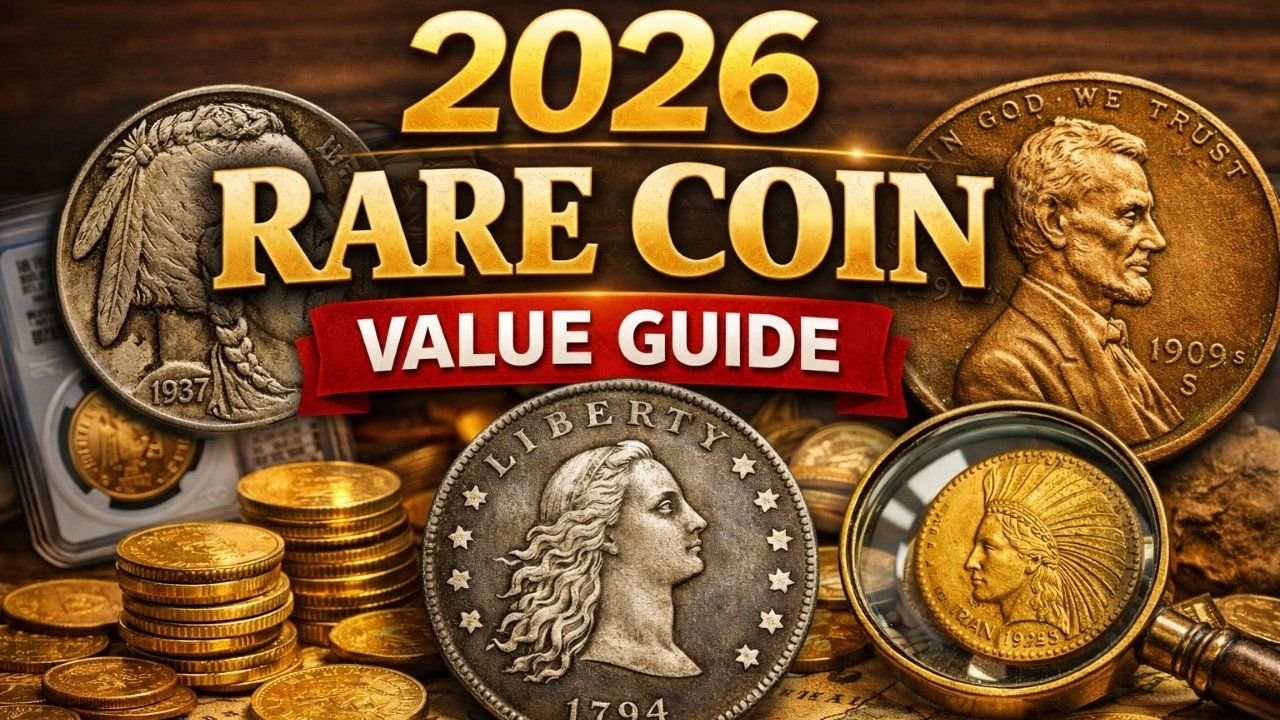
Interest in rare American coins has surged as collectors and investors search for tangible assets with long-term value. Record auction prices and newly rediscovered collections have pushed several historic coins back into the spotlight.
For enthusiasts, these pieces represent far more than old currency. They combine craftsmanship, national history, and extreme rarity—factors that can push values into the millions.
The current market highlights a mix of legendary museum-level coins and unusual minting errors that occasionally surface in private collections. Together, they form the foundation of today’s high-value numismatic market.
Legendary Coins Leading the Market
1933 Saint-Gaudens Double Eagle
Few coins carry the mystique of the 1933 Saint-Gaudens Double Eagle. Although hundreds of thousands were produced, most were melted during the U.S. government’s gold recall in the 1930s.
Only a very small number survived, and just one is legally owned by a private collector. Its rarity and historical context have pushed its market value close to $19 million, making it one of the most coveted coins in existence.
1794 Flowing Hair Silver Dollar
The 1794 Flowing Hair Dollar is widely regarded as the first silver dollar issued by the United States Mint. Its design reflects the early vision of American coinage during the country’s formative years.
High-grade examples have achieved auction results exceeding $10 million, while even lower-grade pieces remain extremely valuable due to their historical significance.
1787 Brasher Doubloon
Created by New York goldsmith Ephraim Brasher, the Brasher Doubloon predates official U.S. Mint coinage. The version marked with the “EB” stamp on the eagle’s breast is considered the rarest.
Collectors prize it as one of the earliest gold coins tied to American history, with prices approaching $9 million in recent private sales.
1849 Double Eagle Gold Coin
Unlike most coins, the 1849 Double Eagle is essentially a prototype. Only a single example is known today, preserved in the Smithsonian Institution.
Experts believe that if it were ever offered for sale, it could exceed $20 million, placing it among the most valuable coins ever created.
1913 Liberty Head Nickel
The 1913 Liberty Head Nickel remains one of the most mysterious coins in U.S. history. Only five examples are known, and they were produced after the design had officially been discontinued.
Whenever one appears at auction, it attracts enormous attention and typically sells for $4.5 million or more.
Valuable Error Coins Still Circulating
While the most famous coins are locked away in collections, certain minting mistakes continue to excite collectors. Some of these rare errors have been discovered in everyday circulation.
| Coin | Error Type | Estimated Value |
|---|---|---|
| 1943 Copper Cent | Bronze planchet error | $250,000 – $1M+ |
| 1965 Silver Dime | Struck on 90% silver planchet | $7,000 – $12,000 |
| 1982-D Small Date Penny | Transitional copper issue | $18,800+ |
| 2004-D Wisconsin Quarter | “Extra Leaf” variety | $1,500 – $3,000 |
These coins illustrate how small manufacturing anomalies can create enormous collector demand decades later.
Other Historic Rarities Worth Millions
1804 Draped Bust Silver Dollar
Often referred to as the “King of American Coins,” the 1804 Draped Bust Dollar was actually produced years after the date stamped on it.
Only a limited number were struck as diplomatic gifts, leaving just a few examples known today. Some have sold for between $6 million and $8 million.
1793 Flowing Hair Chain Cent
This coin represents the very beginning of American copper coinage. Its distinctive chain design sparked controversy during its time but has since become a defining feature for collectors.
Well-preserved examples have reached $1.5 million to $2.5 million at auction.
1907 Saint-Gaudens High Relief
Designed by Augustus Saint-Gaudens, this coin is widely praised for its artistic beauty. The high-relief design required multiple strikes, making production extremely difficult.
As a result, surviving examples regularly exceed $1 million in the collector market.
1885 Trade Dollar
With only a handful known, the 1885 Trade Dollar ranks among the rarest silver coins ever produced by the United States Mint.
Its scarcity has driven prices close to $4 million in recent transactions.
Practical Tips for Evaluating Rare Coins
Check Professional Grading
Condition plays a major role in determining value. Coins authenticated and graded by professional services often command significantly higher prices.
Examine Mint Marks
Small mint marks—such as “S” for San Francisco or “CC” for Carson City—can dramatically increase rarity and collector interest.
Use Trusted Reference Guides
Standard pricing references remain essential tools for collectors. Established guides track auction trends and provide reliable benchmarks for evaluating coin values.
Why the Rare Coin Market Remains Strong
Rare coins occupy a unique space between history, art, and investment. Unlike many collectibles, they combine precious metals with documented historical significance.
As interest in alternative assets continues to grow, these coins remain highly sought after by collectors worldwide. From legendary museum pieces to unexpected error coins, the market continues to reward those who understand the stories behind these extraordinary artifacts.