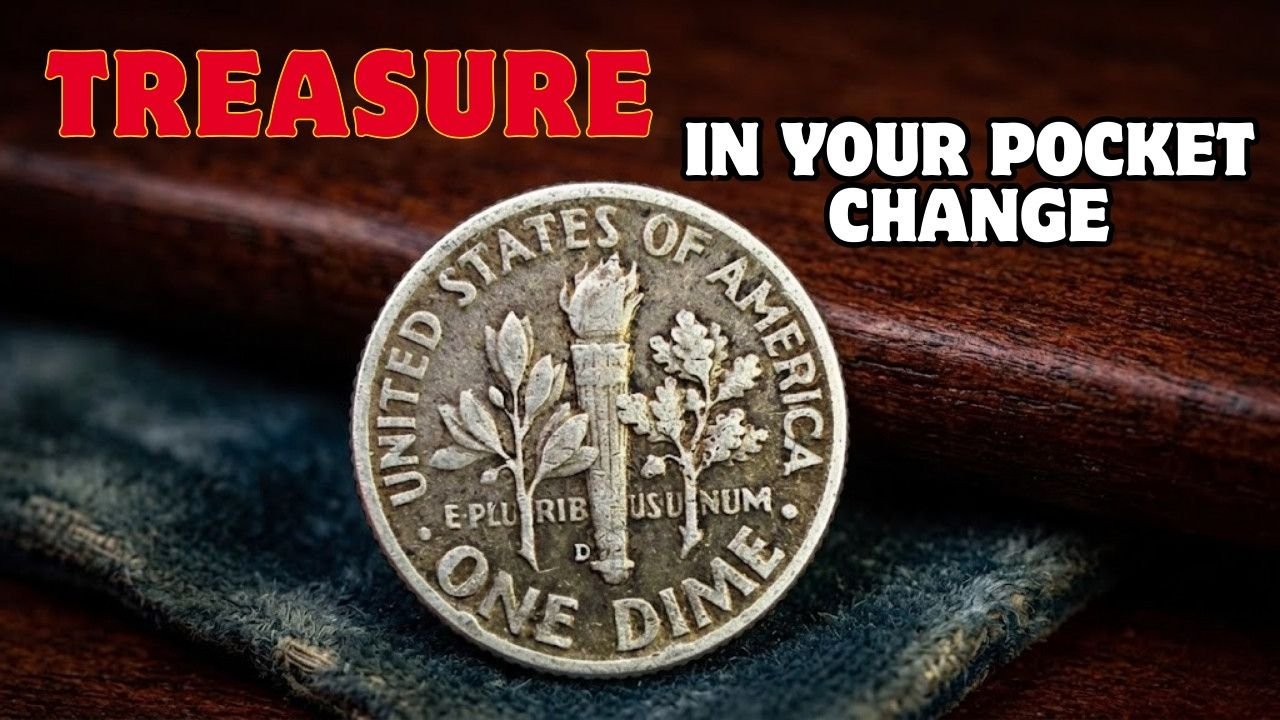
When people think of valuable dimes, the mind often drifts to Mercury dimes or 19th-century coinage. Yet the Roosevelt dime series, introduced in 1946, has quietly produced some of the most remarkable rarities in modern U.S. numismatics. Despite billions being struck for everyday use, a small number of minting errors and special issues have become legendary, commanding prices that rival the most sought-after classic coins. Here are five Roosevelt dimes that could turn ordinary pocket change into a collector’s treasure.
The 1975 “No S” Proof Roosevelt Dime
The 1975 “No S” Proof dime is among the rarest modern American coins. A minting mishap at the San Francisco Mint led to a handful of Proof dimes being released without the “S” mint mark. Today, only two examples are confirmed, making this coin a true trophy for collectors. In 2024, one sold for over $500,000, cementing its status as one of the most coveted Roosevelt dimes.

It’s important to note that only mirror-like Proof coins qualify. Ordinary Philadelphia strikes without a mint mark are common and hold no extraordinary value, so careful inspection is essential.
The 1968 “No S” Proof Roosevelt Dime
The 1968 “No S” Proof marked the first occurrence of a mint mark omission on a Proof Roosevelt dime. About a dozen examples are known today, and they remain highly sought after. High-grade specimens can fetch between $20,000 and $45,000, with the best examples found in their original Proof set packaging. Collectors should verify the absence of the “S” under the date to confirm authenticity.
The 1982 “No P” Roosevelt Dime
Unlike the Proof rarities, the 1982 “No P” dime is a circulation strike. Due to a minting oversight at the Philadelphia Mint, a batch of dimes was released without the “P” mint mark. Since these coins entered everyday commerce, they remain possible to find in circulation today.
Values range from $300 to $2,000 depending on condition, with uncirculated coins commanding the highest premiums. Collectors distinguish between “Strong” and “Weak” strikes—the sharper the torch and details on the reverse, the more valuable the coin.
The 1965 Silver Roosevelt Dime (Wrong Planchet Error)
In 1965, the U.S. Mint transitioned from silver to copper-nickel clad dimes. However, a few leftover silver planchets from 1964 were mistakenly used to strike 1965-dated coins. These transitional errors are rare and highly desirable, with values between $5,000 and $15,000.
Identifying a silver dime is straightforward: examine the edge and weight. Clad dimes display a copper stripe and weigh 2.27 grams, whereas silver dimes have a solid edge and weigh 2.50 grams. This subtle difference can reveal a potentially valuable find.
The 1996-W Roosevelt Dime

To celebrate the 50th anniversary of the Roosevelt dime, the West Point Mint produced a special edition with a “W” mint mark. These coins were included exclusively in 1996 Uncirculated Mint Sets and were never released into circulation.
With a mintage of 1.4 million, these dimes are less rare than error coins, yet high-grade examples (MS68 or MS69) can command $100 to $500. The 1996-W is unique as the only Roosevelt dime ever struck at West Point for a standard set, making it a key collectible for modern Roosevelt series enthusiasts.
Quick Reference Value Chart (2026)
| Year / Mint | Notable Feature | Estimated Value |
|---|---|---|
| 1975 No S | Proof / Missing Mint Mark | $500,000+ |
| 1968 No S | Proof / Missing Mint Mark | $20,000 – $45,000 |
| 1965 Silver | Wrong Metal Error | $5,000 – $15,000 |
| 1982 No P | Missing “P” Mark (Circulated) | $300 – $2,000 |
| 1996-W | West Point Anniversary Issue | $50 – $500 |
How to Handle Rare Finds
If you suspect you’ve discovered one of these hidden treasures, resist the urge to clean it. Even gentle polishing can strip away mint luster, drastically reducing its value. Instead, store the coin in a protective holder, such as a soft plastic flip or archival-quality envelope.
For verification and resale potential, consider submitting the coin to a professional grading service like PCGS or NGC. Authentication confirms rarity and helps maximize market value, ensuring your discovery receives the recognition it deserves.
Final Thoughts
The Roosevelt dime series proves that modern coins can hold extraordinary surprises. From missing mint marks to transitional silver strikes, these hidden gems demonstrate that history and fortune can reside in the smallest denominations. For collectors, the thrill lies not only in the potential value but also in the chase, knowing that a dime worth thousands could be hiding in an overlooked coin jar.
Whether you are a seasoned numismatist or a casual collector, paying attention to Roosevelt dime rarities can turn ordinary pocket change into a collection of extraordinary significance in 2026.